
Keep each hand and the running total visible with a printable canasta score sheet. This collection includes 4 layouts: two editable files with direct downloads. Select a sheet with enough columns for your players or partnerships and enough rows for the length of your game.
2 New Editable Templates with Previews
Choose a layout for the task you need to complete. Each preview shows the actual editable Excel and Word file. Download the template and replace the placeholders or example inputs with your own details.
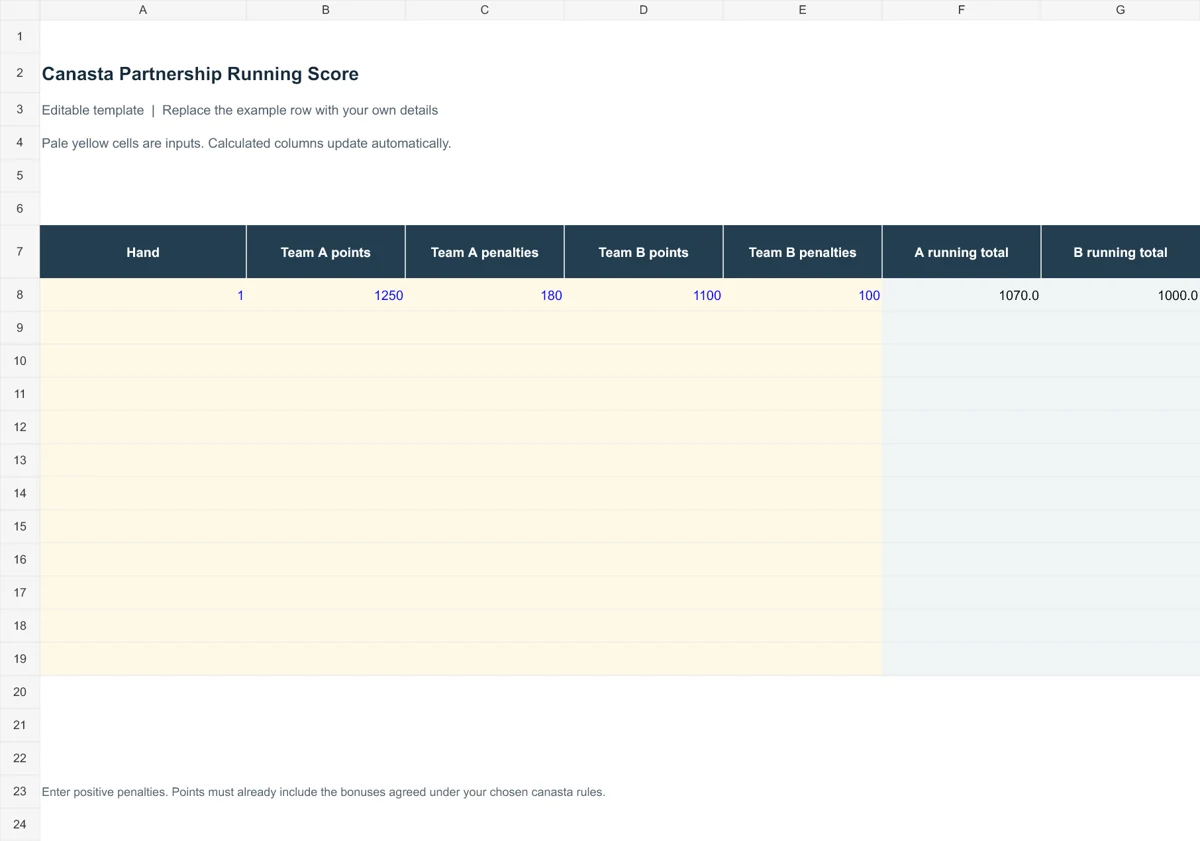
Canasta Partnership Running Score
Calculate net hand scores and running totals for two partnerships. Enter positive penalties. Points must already include the bonuses agreed under your chosen canasta rules.
Download Editable Excel Template
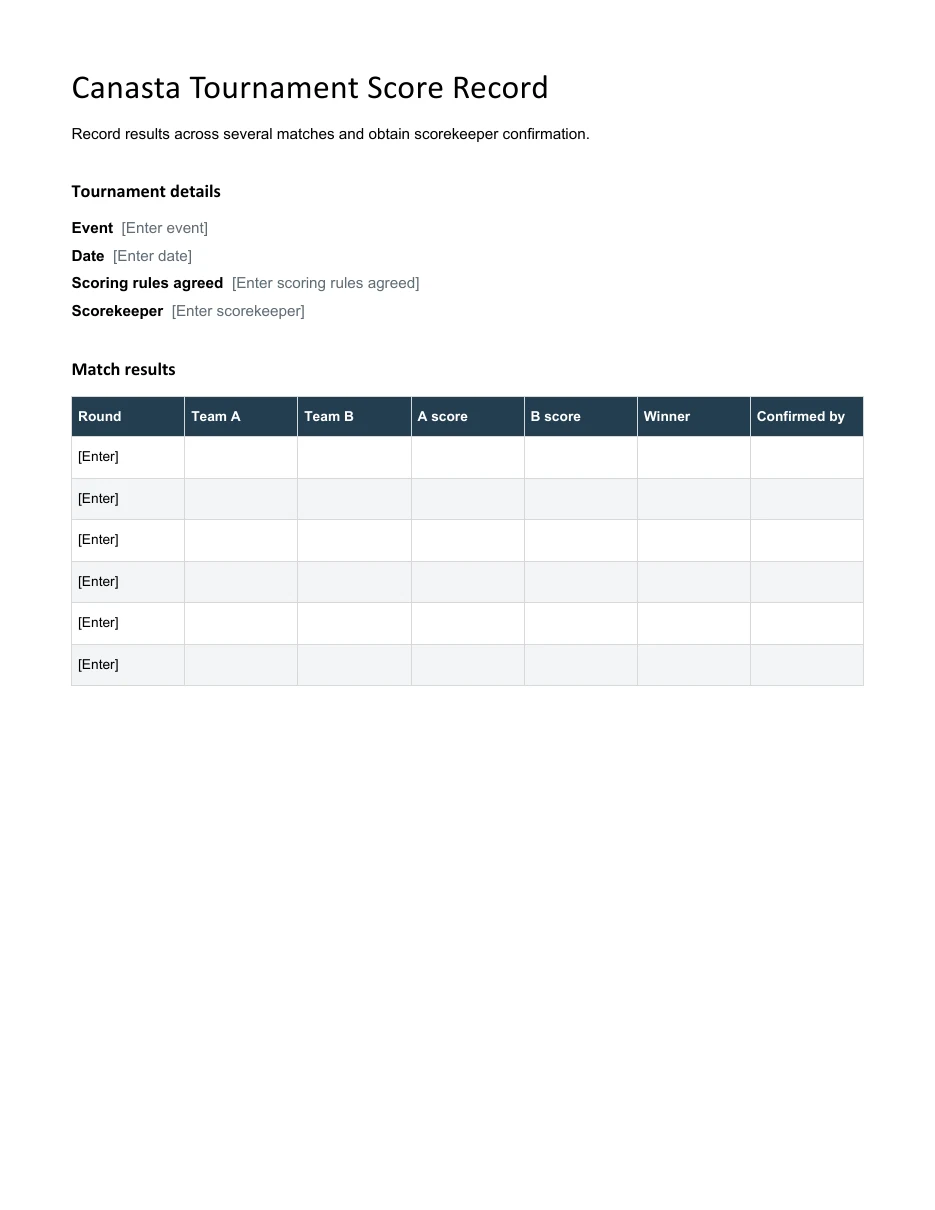
Canasta Tournament Score Record
Record results across several matches and obtain scorekeeper confirmation.
Before the first deal, agree on the variation, target score, and bonuses your group will use. Record meld points, bonus points, and deductions separately so another player can check the arithmetic. The worked example below shows how to keep a round total distinct from the cumulative score.
Go to the two editable templates and preview images and read the practical guidance below.
What Is a Canasta Score Sheet?
A canasta score sheet is a printable table used to record each side’s points after every hand. It usually has columns for each team or player and rows for each hand, along with spaces for the different types of points, such as canasta bonuses, red threes and card values. A running total at the bottom shows who is closest to the winning target.
Since canasta scores can climb into the thousands, writing them down avoids mistakes and disputes. It also lets you review a game later or keep a record for a club or tournament.
For a club session, a sign-in sheet helps identify the players before tables are assigned.
How Canasta Works in Brief
Canasta is played with two decks of cards plus jokers. It can be played by two to six people, but it is most commonly played as a partnership game with two teams of two. Players draw and discard, and lay down groups of three or more cards of the same rank. A group of seven or more cards is called a canasta and earns a bonus. The hand ends when a player goes out, and then points are counted for both sides.
House rules and regional versions differ, so agree on the rules before you start. Popular variations include Samba, Bolivia and Burraco, and the score sheets below can be adapted for them.
How Canasta Scoring Works
Scoring rules can differ slightly, so check the version you play. In many common versions, points come from the following sources:
- Canasta bonuses: A natural (pure) canasta usually scores 500 points, and a mixed canasta 300.
- Going out: The player who goes out often earns a bonus of 100 points.
- Red threes: Each red three is worth a bonus, often 100 points, with a larger bonus for holding all four.
- Card values in melds: Each card laid down scores its value, such as 50 for a joker, 20 for a two or an ace, 10 for cards from eight through king, and 5 for cards from four through seven.
- Penalties: Cards left in your hand at the end are subtracted from your total.
The first side to reach the agreed target, often 5,000 points, wins the game. A score sheet helps you tally all of these items clearly at the end of every hand.
What to Include in a Canasta Score Sheet
- Space for team or player names and the date.
- A row for each hand, with room for at least 10 to 15 hands.
- Columns for canasta bonuses, red threes, going-out bonus and meld points.
- A column for points left in hand, to subtract.
- A hand total and a running total for each side.
- A field showing the target score and the final winner.
If the game night includes shared food, a potluck sign-up sheet helps coordinate what players will bring.
2 Editable Templates with Direct Downloads
Choose one of the two layouts below to suit your needs. Each preview shows the actual editable file, which you can download directly.
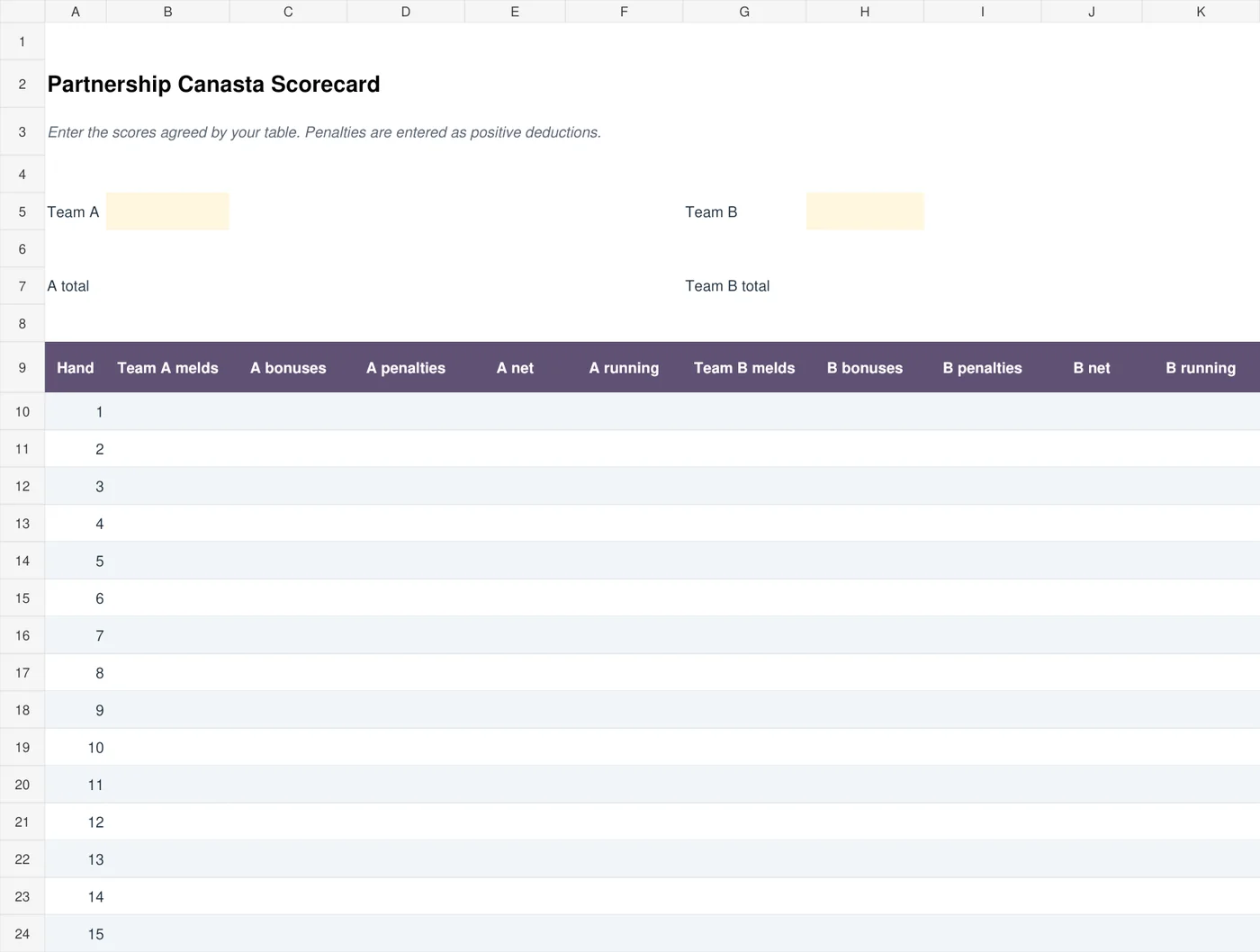
Partnership Canasta Scorecard
Track two teams using separate meld, bonus, and penalty inputs, with hand totals and running scores calculated automatically.
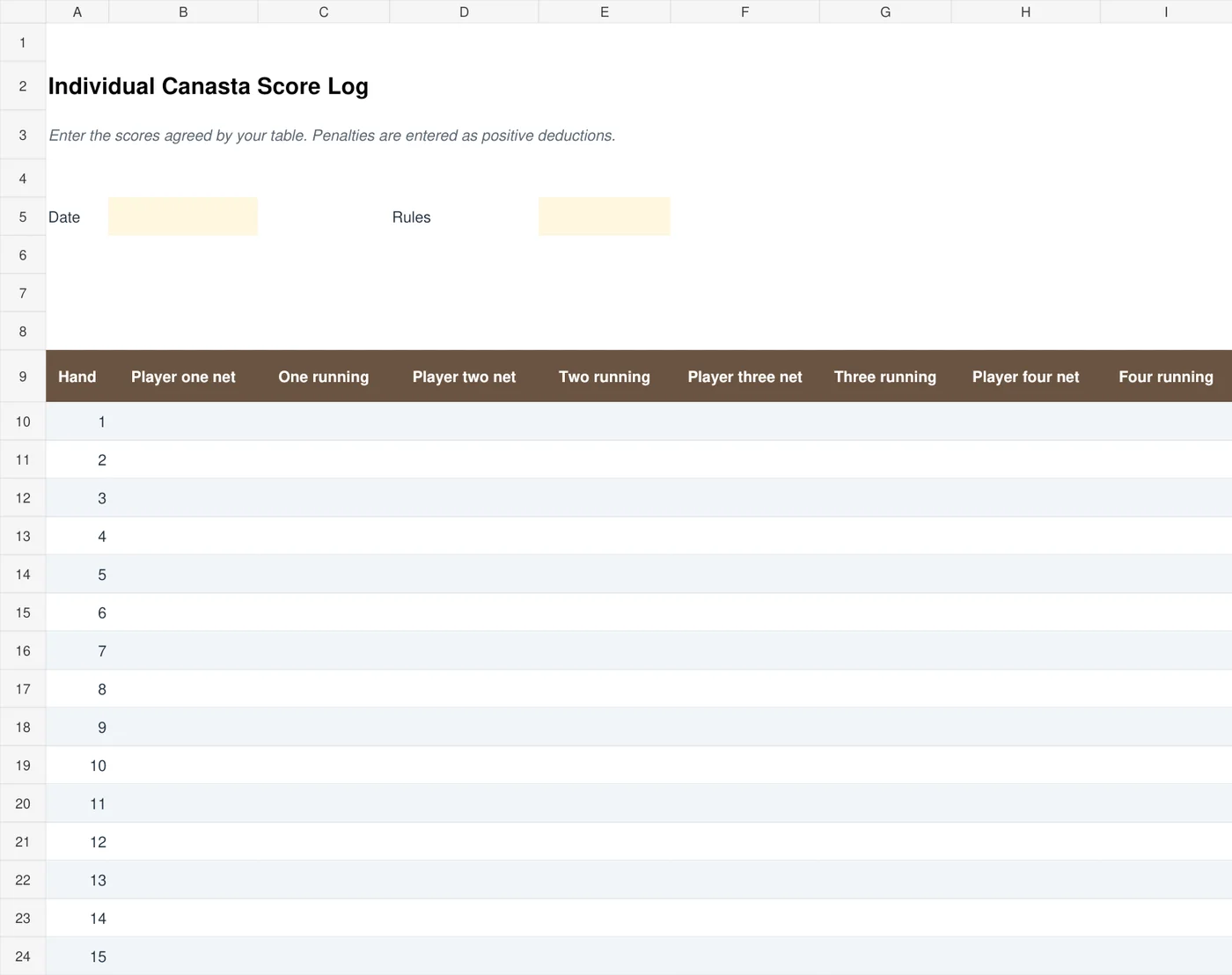
Individual Canasta Score Log
Record each players agreed net score by hand in a four-player layout with individual running totals.
How to Use a Canasta Score Sheet
- Print a sheet, or several if you expect a long game.
- Write the names of the players or teams at the top, plus the date.
- Agree on the target score and any house rules before the first hand.
- At the end of each hand, count and record each side’s canasta bonuses, red threes and meld card values.
- Add the going-out bonus for the player who went out.
- Subtract the value of any cards left in each player’s hand.
- Write the hand total and add it to the running total.
- Check the totals together at the table to make sure that everyone agrees.
- Continue until one side reaches the target score, and circle the winner.
Put recurring game nights on a monthly planner so members can see the dates in advance.
Agreeing on the Score Sheet Before the First Deal
Canasta has several variants, so a good score sheet must match the rules at your table. Before playing, agree on the target score, the bonuses that apply, how penalties are entered, and whether the game ends immediately or after the hand is completed. Write those decisions in a small rules note. This is especially useful when players normally use different household rules, because a familiar-looking printable canasta score sheet does not mean everyone is counting points the same way.
Use the partnership workbook when two teams need separate totals for melds, bonuses, penalties, and running scores. The individual score log gives each player a separate place in the record. Choose one person to enter the scores and another to confirm them after each hand. Rotating these roles between games helps everyone understand the record while avoiding several people editing the same total at once.
A Scorekeeping Example Without Mixing Up Bonuses
Imagine that an agreed scoring system produces 1,250 points in melds and bonuses for one team, with 180 points deducted for cards remaining in hand. The net score for that hand is 1,070. If the team’s previous running total was 2,430, its new total is 3,500. These figures are only an arithmetic example; the actual value of each card, canasta, or bonus must come from the rules you have chosen.
Check whether the meld total already includes a bonus before adding that bonus again in a separate column. Double-counting happens easily when one player announces a combined total and the recorder assumes it represents card values alone. In the direct-download partnership sheet, deductions are entered as positive penalty amounts. Entering a negative number in a field that already subtracts penalties can accidentally increase the score instead.
When a total is disputed, check the current hand before dealing again. Preserve the hand-by-hand entries so the running score can be reconstructed; changing only the final total makes an error harder to trace. On paper, cross out an incorrect value neatly and write the agreed replacement. In Excel, keep a brief correction note if the group wants an audit trail. Print a fresh blank scorecard or save a new workbook for each match so a previous game’s entries cannot be mistaken for the current result.
Tips for Keeping Score Smoothly
- Assign one scorekeeper, and let another player double-check the math.
- Write in pencil, so that corrections are easy.
- Use a simple card-value cheat sheet near the table.
- Keep hand totals and running totals in separate columns to avoid confusion.
- Keep old sheets if you play in a club or league, to track results over time.
A clear score sheet keeps canasta fast, fair and fun. Print one of these 2 free canasta score sheets, agree on the rules, and focus on what matters, which is building canastas and beating the other team.
Frequently Asked Questions (FAQs)
What is a canasta score sheet?
It is a printed table used to record the points each team or player earns in every hand of canasta, plus the running totals that decide the winner.
How many players can play canasta?
Canasta can be played by two to six people. The most popular format is a partnership game for four players in two teams of two, though two- and three-handed versions also exist.
How many points do you need to win at canasta?
Many games are played to 5,000 points, while some versions use 7,500 or another agreed target. Decide on the target before the game begins.
Are these canasta score sheets free?
Yes. The two Excel score sheets at the top are free to download directly, edit, and print. The other samples link to their original sources.
Can I use these sheets for Samba, Bolivia or Burraco?
Yes. These games follow similar scoring ideas, so you can adapt any sheet by relabeling the columns. Just make sure your columns match the bonuses and penalties in the rules you play.
What is the difference between a natural and a mixed canasta?
A natural canasta contains seven or more cards of the same rank with no wild cards, while a mixed canasta includes at least one wild card. Natural canastas score a higher bonus.
Can I keep score on a phone instead?
You can, but many players prefer paper because everyone at the table can see it. A printed sheet also works when you have no signal or battery.
How should we correct a scoring mistake from an earlier hand?
Agree on the corrected hand score with the other players, then update every later running total affected by it. Keep a brief correction note so the final score can still be traced back through the completed hands.


You must be logged in to post a comment.