Polyatomic ions show up all through chemistry, from naming compounds to balancing equations to lab work. Because so many of them look alike, most teachers ask students to memorize them, and a clear polyatomic ion chart makes that task far easier. A good chart shows each ion’s name, formula, and charge in one place so you can study, review, and check your work quickly.
This page offers 5 free, printable polyatomic ion charts in PDF format. Below the gallery, you will find a quick reference table of the most common polyatomic ions, an explanation of how they work, tips for memorizing them, and answers to frequently asked questions.
What Is a Polyatomic Ion?
A polyatomic ion is a group of two or more atoms bonded together that carries an overall electrical charge. The atoms in the group act as a single unit in chemical reactions. For example, the sulfate ion is made of one sulfur atom and four oxygen atoms, and the whole group carries a charge of 2-.
Polyatomic ions are the building blocks of many ionic compounds. When you write the formula for a compound such as calcium nitrate or sodium sulfate, you need to know the formula and charge of the polyatomic ion involved. That is exactly what a polyatomic ion chart provides.
Common Polyatomic Ions Quick Reference
Here are some of the most common polyatomic ions taught in general chemistry. Always check your own textbook or teacher’s list, since courses sometimes emphasize different ions.
| Ion Name | Formula | Charge |
|---|---|---|
| Ammonium | NH4 | 1+ |
| Hydroxide | OH | 1- |
| Nitrate | NO3 | 1- |
| Nitrite | NO2 | 1- |
| Acetate | C2H3O2 | 1- |
| Bicarbonate (hydrogen carbonate) | HCO3 | 1- |
| Permanganate | MnO4 | 1- |
| Cyanide | CN | 1- |
| Carbonate | CO3 | 2- |
| Sulfate | SO4 | 2- |
| Sulfite | SO3 | 2- |
| Chromate | CrO4 | 2- |
| Dichromate | Cr2O7 | 2- |
| Oxalate | C2O4 | 2- |
| Phosphate | PO4 | 3- |
The ammonium ion is the only common polyatomic cation in this list. Almost all of the others are anions, meaning they carry a negative charge.
Why Use a Polyatomic Ion Chart?
- Faster memorization: Seeing names, formulas, and charges together helps the information stick.
- Accurate formulas: Knowing each ion’s charge is essential for writing correct compound formulas.
- Easy exam prep: A printed chart is ideal for quick review before quizzes and tests.
- Useful in the lab: Keep a chart at your bench when working with ionic compounds and solutions.
- Helpful for teachers: Print copies for the whole class or display one on the wall.
Free Printable Polyatomic Ion Charts
Click any chart to view it at full size, then use the download button to save the printable PDF version.
Sample Polyatomic Ions Chart


Polyatomic Ions Chart to Download

Polyatomic Ions Chart for Students

Free Polyatomic Ions Chart
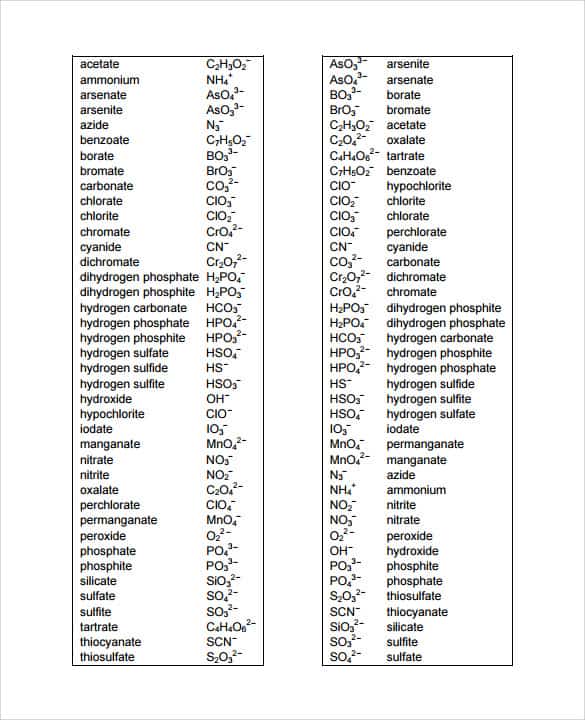
Common Polyatomic Ions Chart
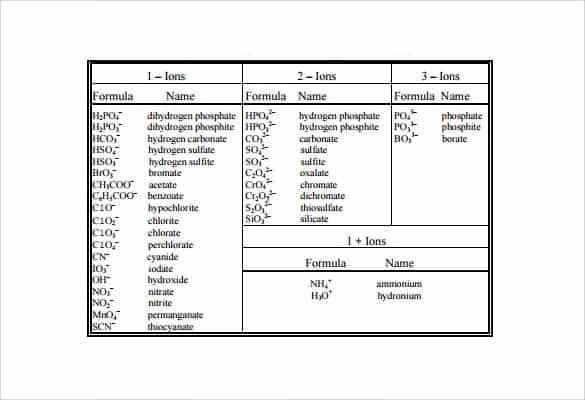
How to Use a Polyatomic Ion Chart
- Find the ion. Look up the polyatomic ion by name or formula on the chart.
- Note the charge. Write down the charge, since it decides how many ions are needed to balance a compound.
- Pair it with a partner ion. Choose the metal or other ion that will combine with it.
- Balance the charges. Use the smallest whole-number ratio so total positive and negative charges cancel out.
- Use parentheses when needed. If you need more than one polyatomic ion, put the ion in parentheses with a subscript, such as Ca(NO3)2.
- Name the compound. Write the cation name first, then the polyatomic ion name.
Tips for Memorizing Polyatomic Ions
- Learn the ions in groups by charge, such as all the 1- ions first.
- Notice patterns in the names. Ions ending in “-ate” usually have one more oxygen than the matching “-ite” ion, such as sulfate (SO4) and sulfite (SO3).
- Make flashcards with the name on one side and the formula and charge on the other.
- Practice writing compound formulas, such as sodium carbonate or magnesium hydroxide, instead of only reading the list.
- Use short review sessions every day rather than one long cram session.
- Quiz yourself or a friend using a blank chart, and check answers against a completed one.
Note: These charts are study aids. Course lists can differ, so always compare with the ions required by your textbook, teacher, or exam board.
Frequently Asked Questions (FAQs)
What is a polyatomic ion chart?
It is a reference table listing polyatomic ions with their names, chemical formulas, and charges. Students use it to write formulas, name compounds, and study for chemistry tests.
Are these polyatomic ion charts free to print?
Yes. All the charts on this page are free to download and print for study or classroom use.
What is the most common polyatomic cation?
The ammonium ion, NH4, with a 1+ charge, is the most commonly taught polyatomic cation.
Which polyatomic ions should I memorize first?
Start with the ones that appear most often in class: nitrate, sulfate, carbonate, phosphate, hydroxide, and ammonium. Then add the rest of your teacher’s list.
What does the “-ate” and “-ite” ending mean?
For ions made from the same central atom, the “-ate” ion usually has one more oxygen atom than the “-ite” ion. For example, nitrate is NO3 while nitrite is NO2.
Why do polyatomic ions need parentheses in formulas?
When more than one of the same polyatomic ion is needed, parentheses show that the subscript applies to the whole group of atoms, as in Mg(OH)2.
Can teachers use these charts in the classroom?
Yes. They are suitable for handouts, wall posters, lab benches, and test-prep packets.
Final Thoughts
A clear polyatomic ion chart turns a long memorization task into a manageable study routine. Download one of these 5 free printable charts, keep it with your chemistry notes, and practice a few ions every day until they become second nature.




You must be logged in to post a comment.