An employee write up form is more useful when it records specific facts and a clear next step. Note the incident date, the relevant expectation, what was observed, and the employee’s response instead of filling the page with broad judgments about attitude or character.
2 New Editable Templates with Previews
Choose a layout for the task you need to complete. Each preview shows the actual editable Word file. Download the template and replace the placeholders or example inputs with your own details.
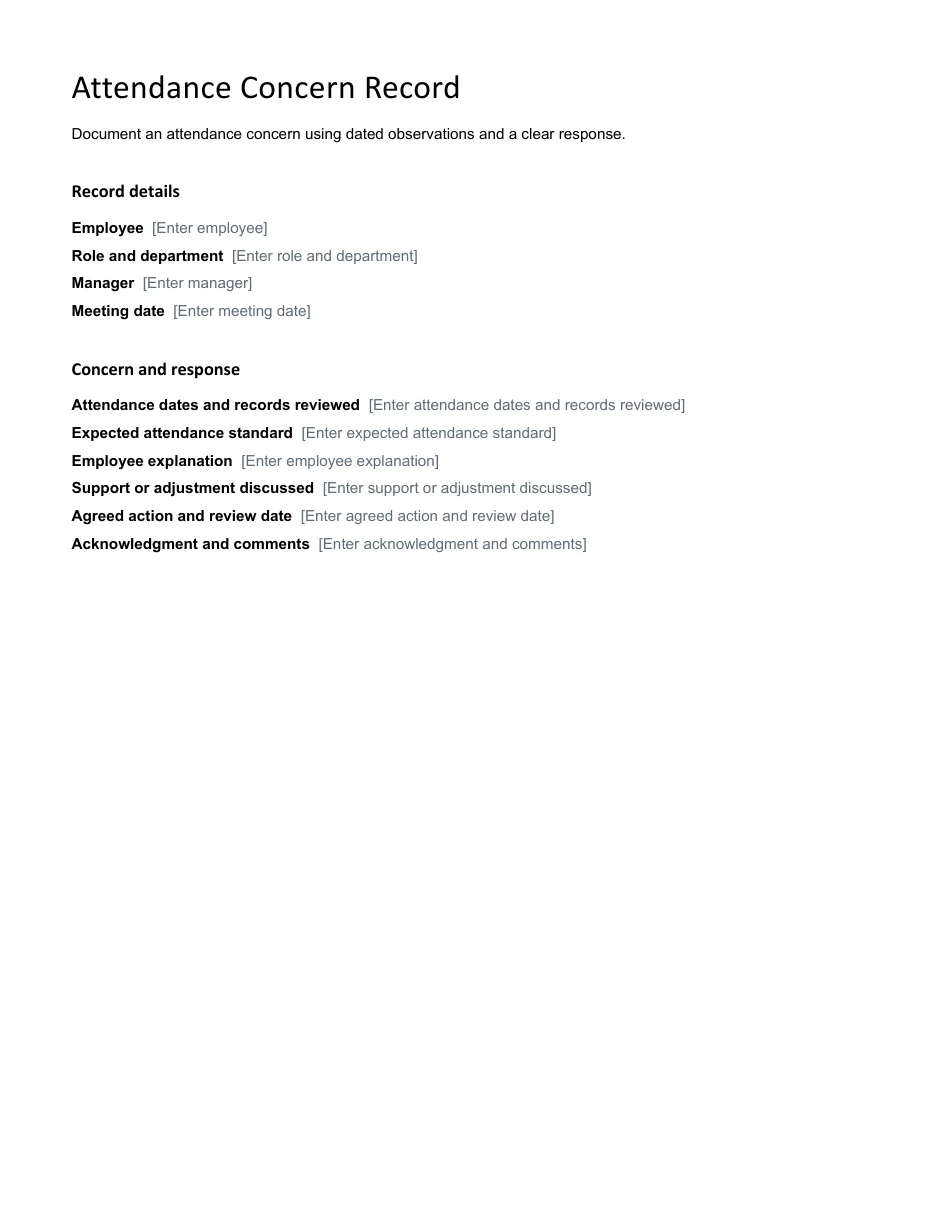
Attendance Concern Record
Document an attendance concern using dated observations and a clear response.
Download Editable Word Template
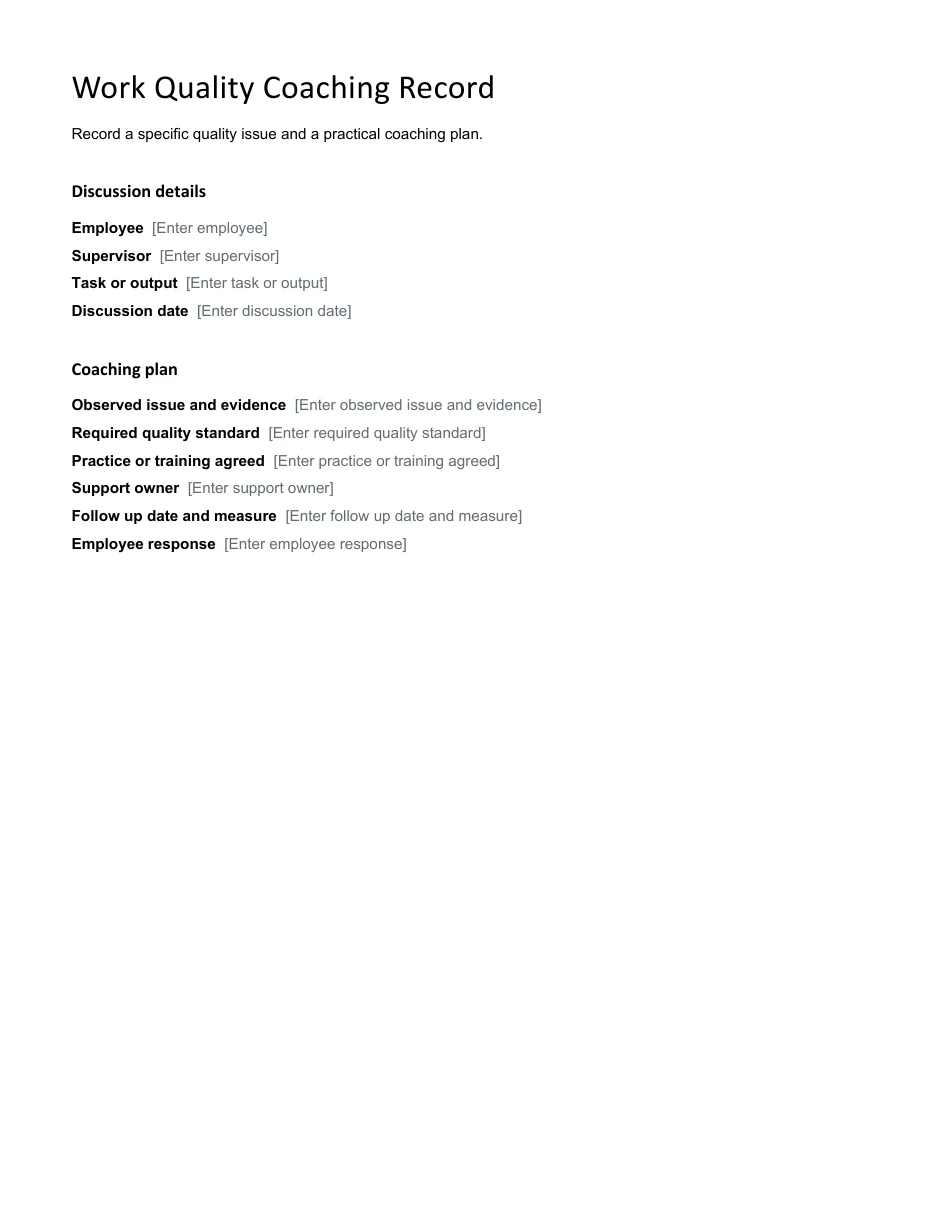
Work Quality Coaching Record
Record a specific quality issue and a practical coaching plan.
The forms below offer starting points for an incident record or an improvement discussion. Adapt the wording to the situation and your organization’s process. A measurable action, a realistic review date, and space for the employee’s comments make the document easier to use during follow-up than a warning with no explanation of what improvement looks like.
Go to the two editable templates and preview images and read the practical guidance below.
What Is an Employee Write Up Form?
An employee write up form, sometimes called a disciplinary action form, warning notice or corrective action form, is a document used by a manager or supervisor to formally record an employee’s misconduct, policy violation or performance problem. It describes the issue, refers to the rule or standard that was not met, states the expected improvement and records any consequence if the problem continues.
The form is usually signed by the manager and the employee, then placed in the employee’s personnel file. The employee’s signature normally shows that they received and read the form, and not necessarily that they agree with it.
Why Use a Write Up Form?
- Documents the issue: Facts, dates and details are written down while they are fresh.
- Communicates expectations: The employee knows exactly what the problem is and what needs to improve.
- Supports fair treatment: A standard form helps managers handle similar situations consistently.
- Protects the company: A clear record can be valuable if a disciplinary decision is questioned later.
- Encourages improvement: A specific plan gives the employee a chance to correct the problem.
- Supports progressive discipline: The form shows each step, from verbal warning to written warning and beyond.
When additional instruction is part of the improvement plan, use a training checklist to track the agreed training.
What to Include in an Employee Write Up Form
- Company name and logo.
- Employee name, ID number, job title and department.
- Manager or supervisor name.
- Date of the write up and date of the incident.
- Type of warning: verbal, first written, second written, final warning or other.
- A factual description of the incident or performance issue, including times, places and witnesses.
- The company policy, rule or standard that was violated.
- Previous discussions or warnings on the same issue, with dates.
- The expected improvement, a plan and a timeline for follow-up.
- The consequence if the problem continues.
- The employee’s comments or response.
- Signatures and dates for the manager, the employee and, if needed, HR or a witness.
For an attendance-related concern, check the dated attendance records before describing the incident.
Common Reasons for a Write Up
- Repeated lateness or unexcused absences.
- Poor work quality or missed deadlines.
- Violation of safety rules.
- Inappropriate behavior or conflict with coworkers.
- Failure to follow instructions or company procedures.
- Misuse of company property or time.
2 Editable Templates with Direct Downloads
Choose one of the two layouts below to suit your needs. Each preview shows the actual editable file, which you can download directly.
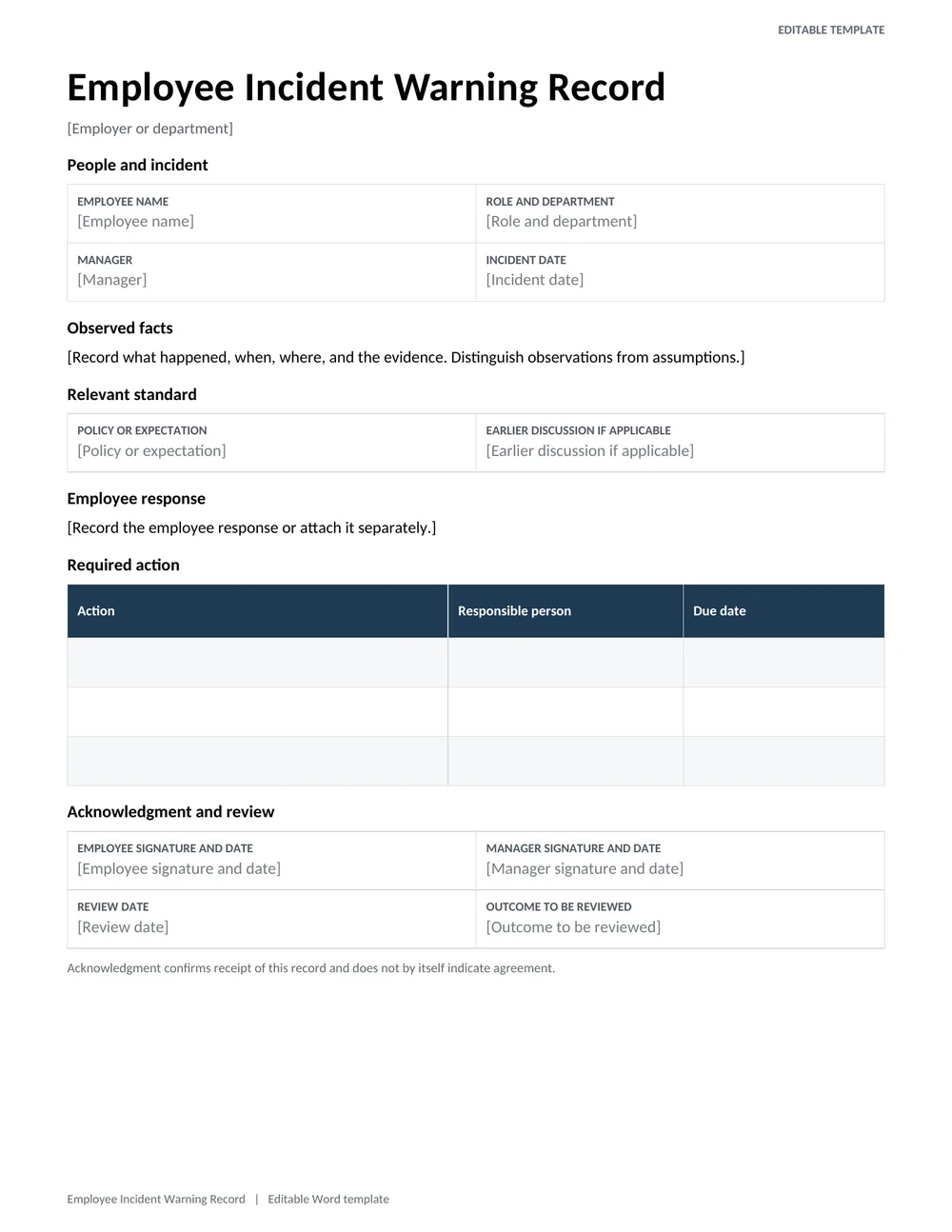
Employee Incident Warning Record
Document a specific incident with dates, observed facts, the relevant policy, the employee response, and a clear follow-up action.
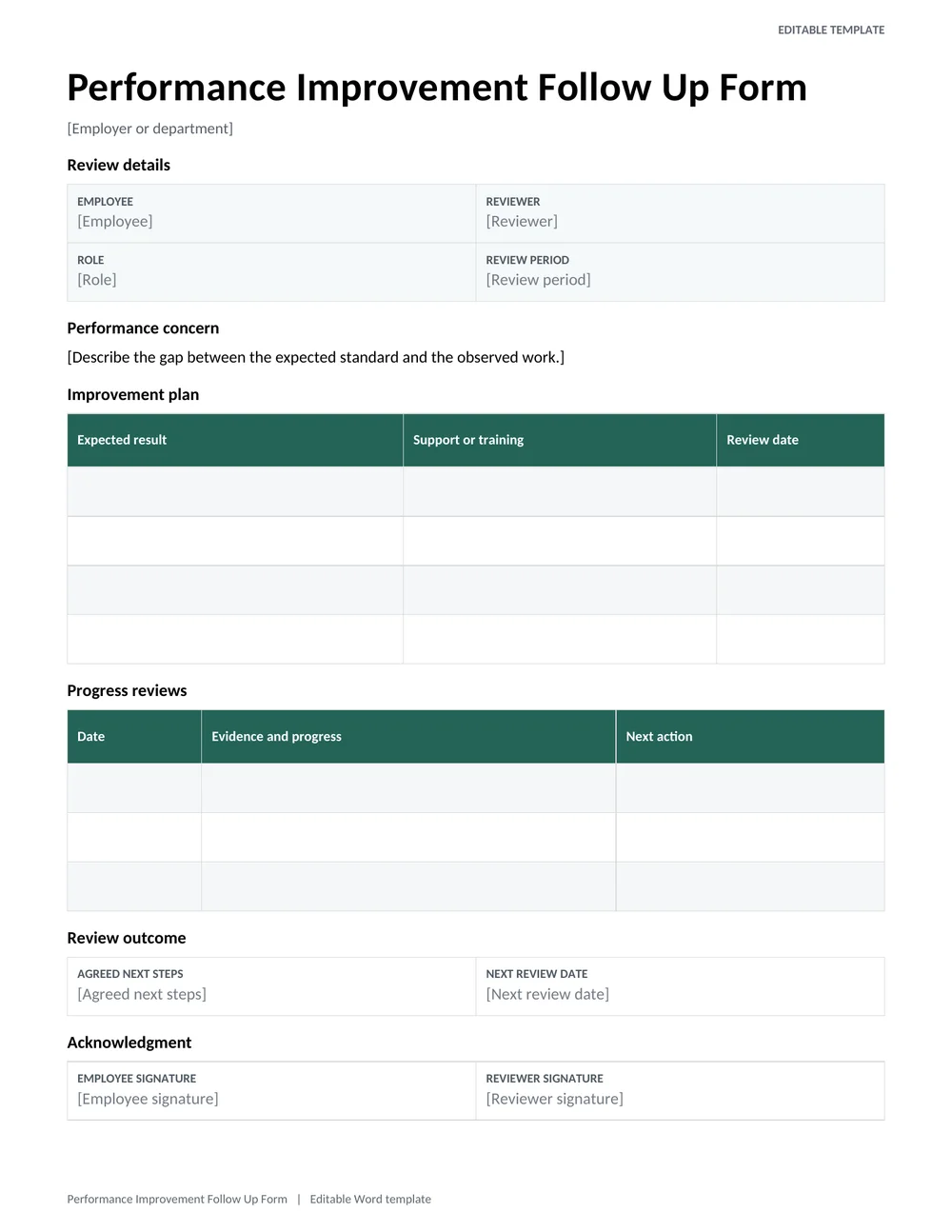
Performance Improvement Follow Up Form
Turn a performance discussion into measurable expectations, support actions, review dates, and recorded progress.
How to Write Up an Employee
- Review company policy and confirm that the behavior or performance issue is a real violation.
- Gather the facts: dates, times, witnesses and any documents or records.
- Choose the correct form and fill in the employee’s details and your own.
- Describe the issue objectively. Stick to what you saw or can prove, and avoid opinions or emotional language.
- Cite the specific policy or standard that was not met.
- Note any prior conversations or warnings.
- Explain what needs to change, by when, and what support you will offer.
- Meet privately with the employee, go through the form, listen to their response and record it.
- Ask the employee to sign to confirm they received it, and give them a copy.
- Send the original to HR for the personnel file, and schedule a follow-up.
If the outcome includes an approved role or schedule change, record it separately on an employee status change form.
A write up records an incident and the required improvement. If employment later ends, prepare a separate termination letter reflecting the actual decision and applicable process instead of treating the warning as a dismissal notice.
Separating an Incident Record From a Performance Plan
An employee incident warning record describes a specific event and the response to it. A performance improvement follow-up form tracks whether agreed changes are happening over time. These documents can support the same process, but they should not be treated as interchangeable. A single late delivery might require fact-finding, while a recurring failure to meet a clearly explained standard may call for a structured review and support plan.
Write observable details before drawing conclusions. “The customer report was submitted at 4:20 p.m. on Tuesday, after the agreed noon deadline” is more useful than “the employee is careless.” Identify the source of the information, the expected standard, and any relevant context. Allow space for the employee’s explanation, including workload, unclear instructions, missing access, or a disputed account. A fair record distinguishes verified facts from statements that still need checking.
Making the Improvement Requirement Measurable
Suppose a team member has submitted three weekly reports after the agreed deadline. An actionable follow-up plan could state that the next four reports should be submitted by noon each Friday, with a short progress check on Thursday. It can also name the support provided, such as access to the reporting system or clarification of the required figures. The example establishes an observable outcome and review period without pretending that the same response suits every workplace.
Do not measure improvement only through a vague rating such as “better attitude.” Describe the behavior needed, how it will be checked, who will provide support, and when the next discussion will happen. If the problem concerns a process outside the employee’s control, record that dependency. Holding someone responsible for missing information they could not obtain produces a weak record and does little to solve the underlying issue.
At follow-up, record the outcome against the stated expectation rather than rewriting the original concern. Note improvement, remaining issues, and any agreed adjustment. Keep the incident record, employee response, and review notes together with access restricted to the appropriate people. Before choosing disciplinary consequences, involve the responsible HR reviewer and apply the relevant workplace policy and local requirements. A downloaded employee write up form organizes documentation; it does not decide whether a warning or any other employment action is appropriate.
Tips for Fair and Effective Write Ups
- Treat similar behavior the same way for all employees.
- Address problems soon after they happen, not weeks later.
- Be specific. “Arrived 20 minutes late on May 3” is better than “has attendance problems.”
- Mention positive qualities and past strengths where relevant, to keep the tone constructive.
- Keep the discussion private and respectful.
- Follow your company’s progressive discipline policy, and involve HR for serious matters.
These forms are general examples and are not legal advice. Employment laws and company policies differ by location, so consult your HR department or an employment lawyer before taking disciplinary action.
A good write up form makes tough conversations clearer and fairer. Use these 2 free employee write up form examples as a starting point, keep your documentation factual and consistent, and focus on helping employees meet expectations.
Frequently Asked Questions (FAQs)
What is an employee write up?
It is a written record of a problem with an employee’s behavior or performance. It states what happened, which rule was broken, what must change and what could happen if it does not.
Is a write up the same as a warning?
Often yes. A write up is commonly a written warning. Some companies use it for any formal documentation of a problem, including coaching notes that come before an official warning.
Does an employee have to sign a write up?
Employees are usually asked to sign to confirm they received it. If they refuse, the manager can note the refusal on the form, ideally with a witness, and keep the record.
Are these employee write up forms free?
Yes. Download the two editable Word forms at the top directly. The remaining examples link to their original sources and can be viewed as models.
How long should write ups stay in an employee’s file?
It depends on company policy and local law. Many organizations keep them for a set period, such as one to three years, or for as long as the employee works there. Check your policy and consult HR.
Can an employee respond to a write up?
Yes, and they should be given the chance. Many forms include a section for employee comments, and the employee may add their side of the story.
What should I do before writing someone up?
Check the policy, collect the facts, consider whether a verbal conversation or coaching is more appropriate and confirm with HR if the situation is serious. Fair and consistent handling protects both the employee and the company.
What if the employee disagrees with the account?
Record the employee’s response alongside the manager’s account and identify any evidence still to be checked. Distinguish disputed statements from confirmed facts. Use the organization’s review process rather than deleting the disagreement from the record.