
A force field analysis template helps a team examine what supports a proposed change and what makes it difficult. Begin with one specific change, then record the driving and restraining forces in enough detail to discuss evidence, priorities, and possible actions.
1 New Editable Templates with Previews
Choose a layout for the task you need to complete. Each preview shows the actual editable Excel file. Download the template and replace the placeholders or example inputs with your own details.
Force Field Action Prioritization
Compare driving and restraining forces using an explicitly chosen scale, then assign actions. Use scores from 1 weak to 5 strong as a discussion aid. A positive net score is not an automatic decision.
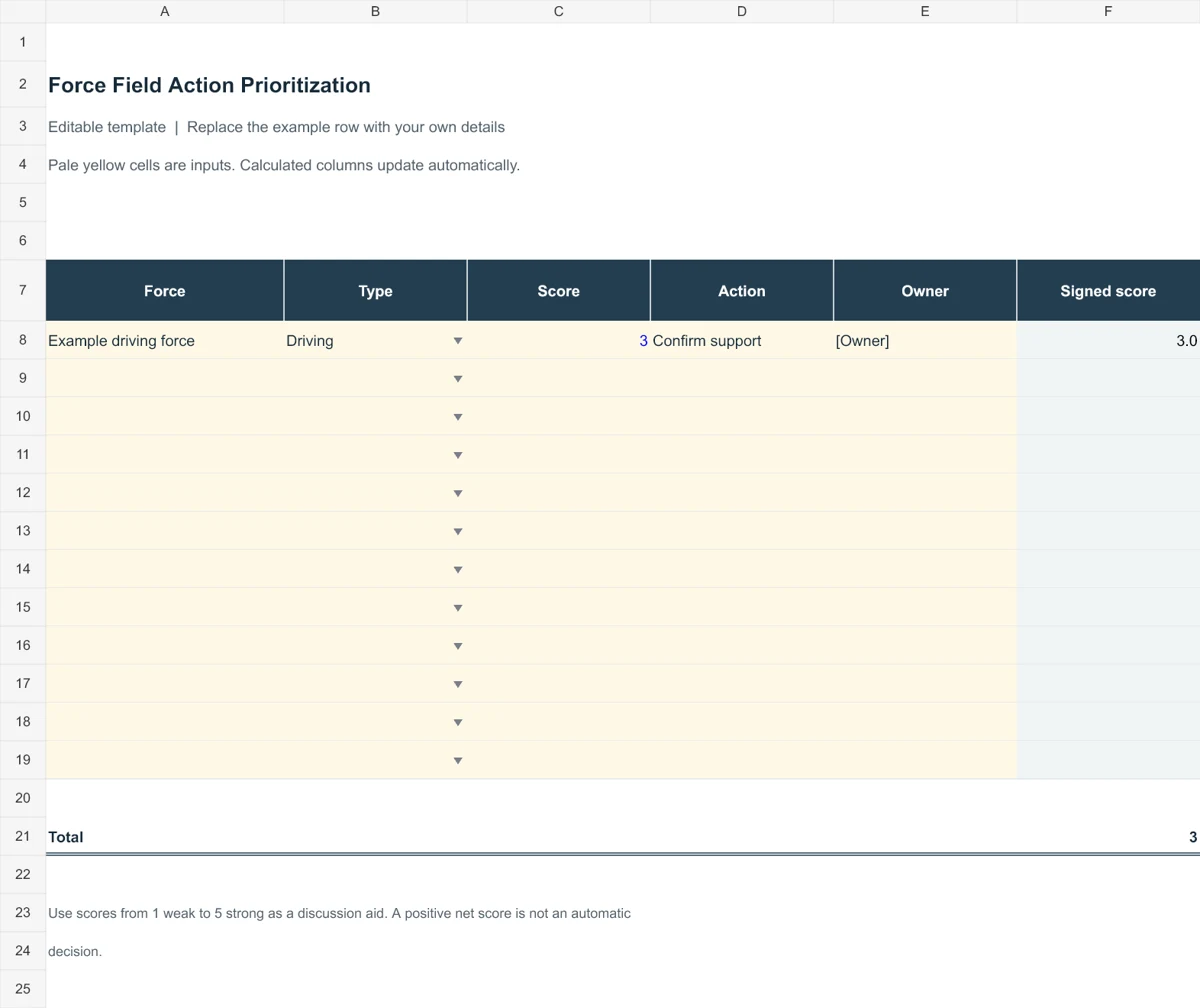
The 12 layouts below offer different ways to present that discussion. Some include direct downloads; others are visual examples. The guide explains how to define the question, use a consistent scoring scale, work through a realistic example, and turn the discussion into a reviewable action plan.
View the template previews and available download buttons, or continue for the practical guide.
What Is Force Field Analysis?
Force field analysis is a decision-making and change-management tool developed by psychologist Kurt Lewin. It treats any situation as a balance between driving forces, which support change, and restraining forces, which resist it. By listing and rating each force, you can see whether the change is likely to succeed and where to focus your efforts.
Managers, team leaders, project managers, and consultants use it to plan initiatives, but it works just as well for personal decisions such as changing careers or moving to a new city.
Summarize the change objective and boundaries in a project overview before scoring the forces.
Why Use a Force Field Analysis Template?
- Clear structure. Two columns, driving forces and restraining forces, make the balance easy to see.
- Faster workshops. A ready-made layout lets your team start listing forces right away.
- Better decisions. Scoring forces helps you decide whether to go ahead, revise, or stop.
- Fewer mistakes. A template reminds beginners to consider both sides rather than only the positives.
Key Parts of a Force Field Analysis
- A clear statement of the current situation and the desired change
- A list of driving forces supporting the change
- A list of restraining forces opposing it
- A score, often from 1 to 5, for the strength of each force
- Total scores for each side
- An action plan to strengthen drivers and reduce barriers
Turn agreed actions for reducing barriers into a project schedule with owners and dates.
2 New Editable Templates with Word and PDF Downloads
Choose from two different designs below. Each includes an editable Word file, a matching printable PDF, and a preview of the actual template. Older entries marked Preview Only are reference images without a downloadable template file.
Career Change Force Field Analysis
A personal career-change force field worksheet with opposing force lists, a scoring scale, assumptions and manageable actions.
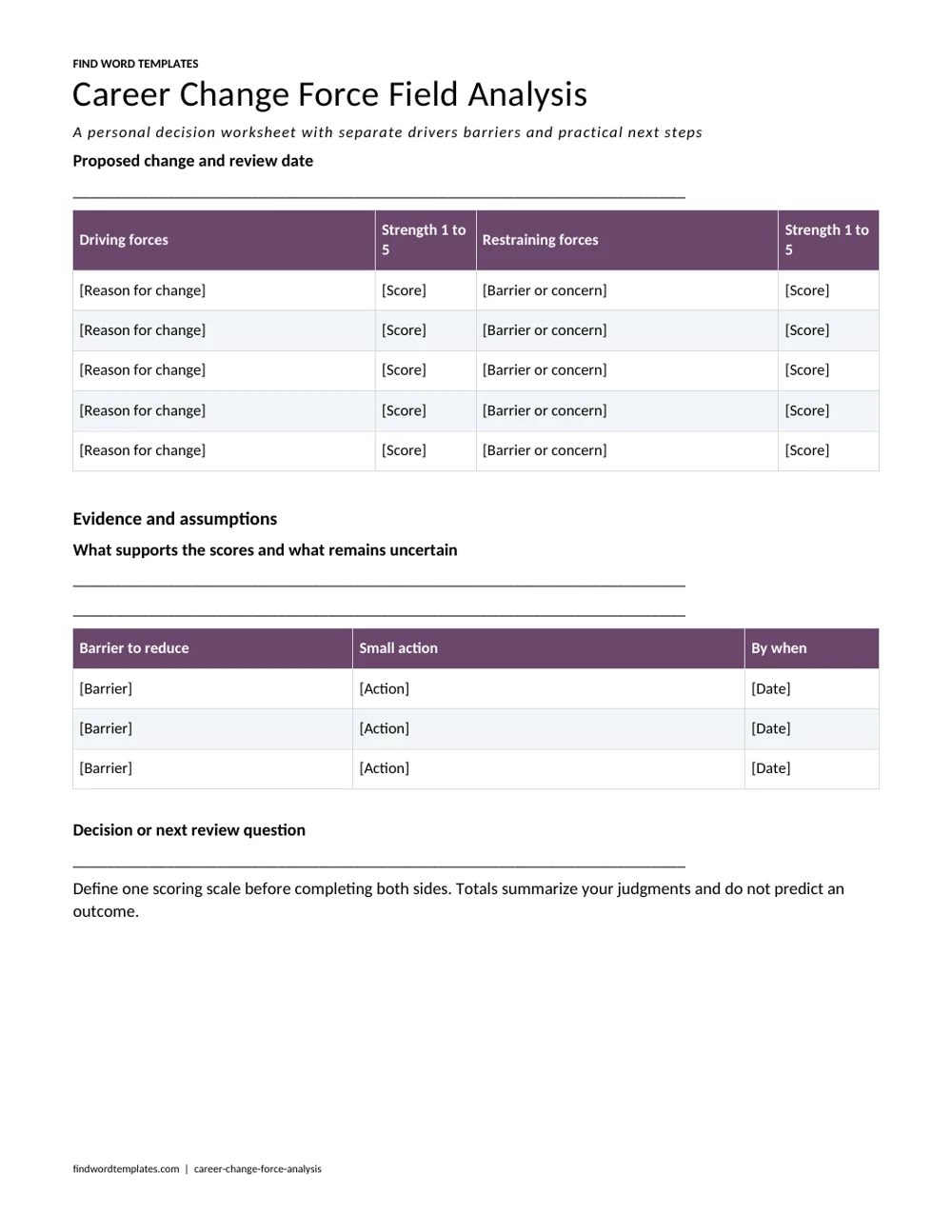
Download Editable Word Template Download Printable PDF
Organizational Change Force Field
An organizational change workshop form with stakeholder evidence, force classification, scores and an accountable review plan.
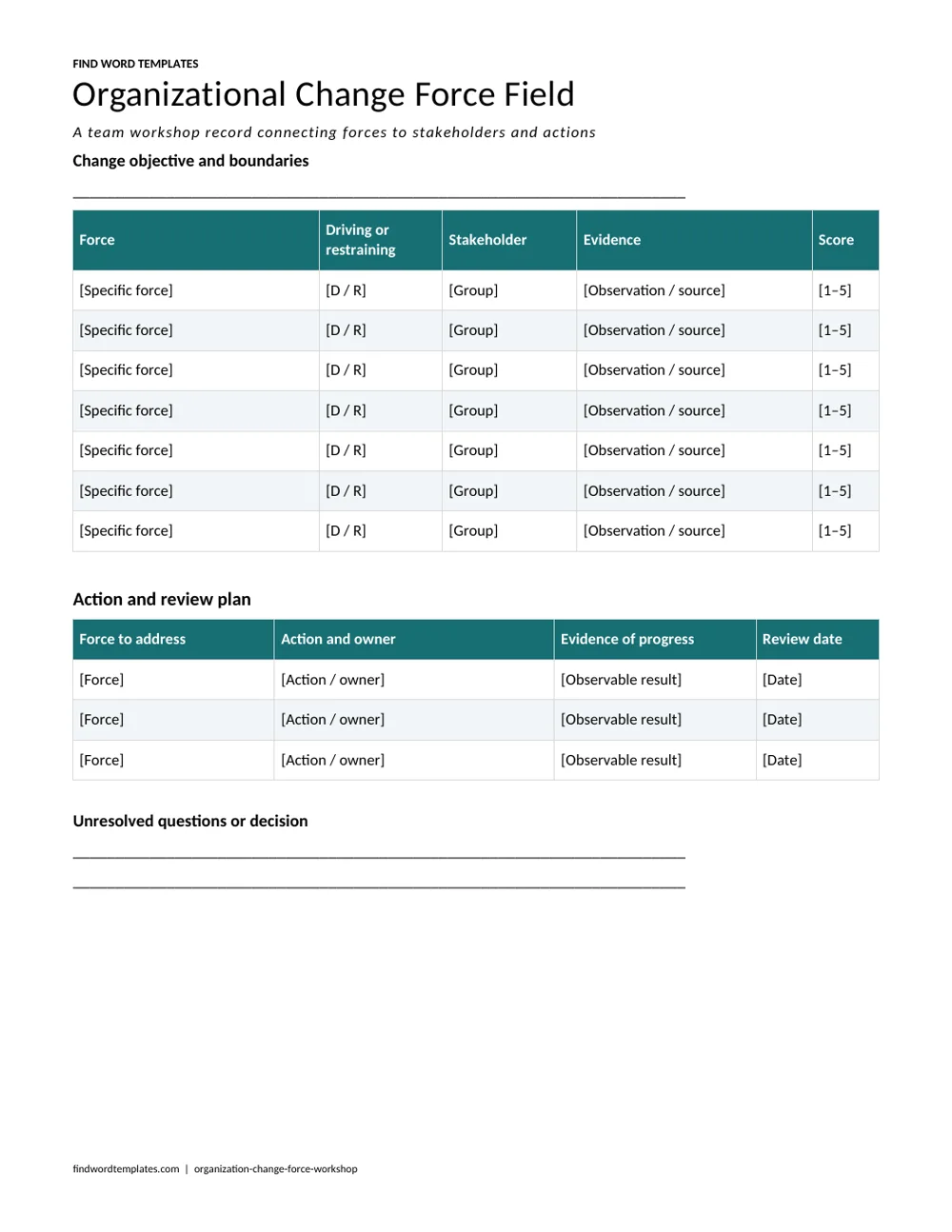
2 Additional Force Field Analysis Templates
Choose the layout that fits your task. Each preview shows the actual PDF; download it to print or complete the available form fields in a PDF reader.
Stakeholder Force Field Canvas
A landscape stakeholder-led force field canvas with opposed force lists, evidence, scores, and follow-up actions.
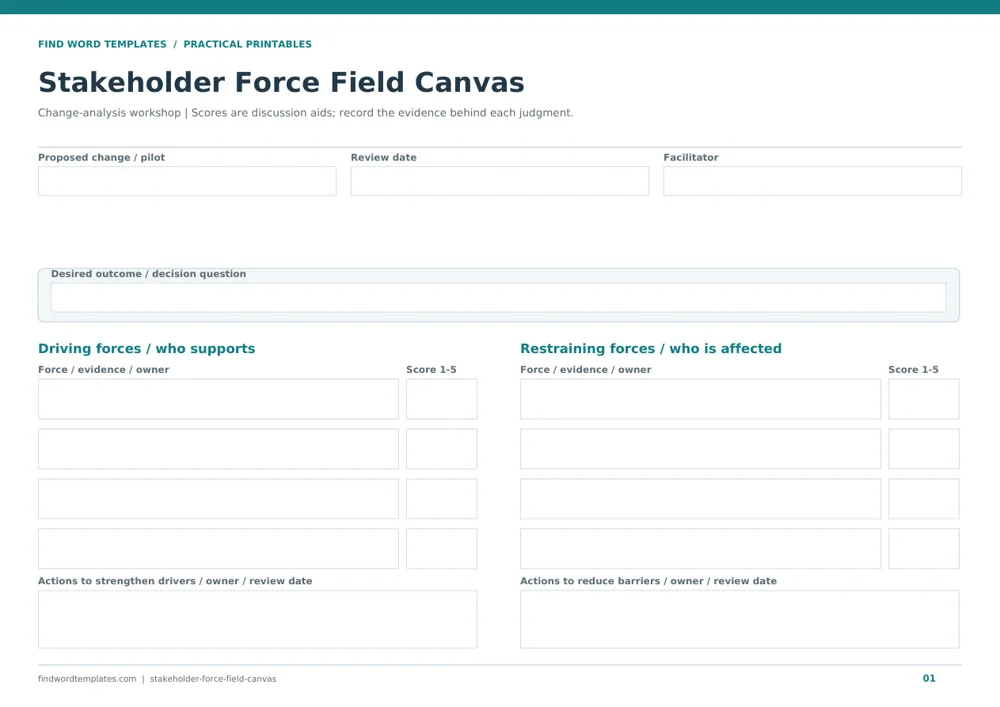
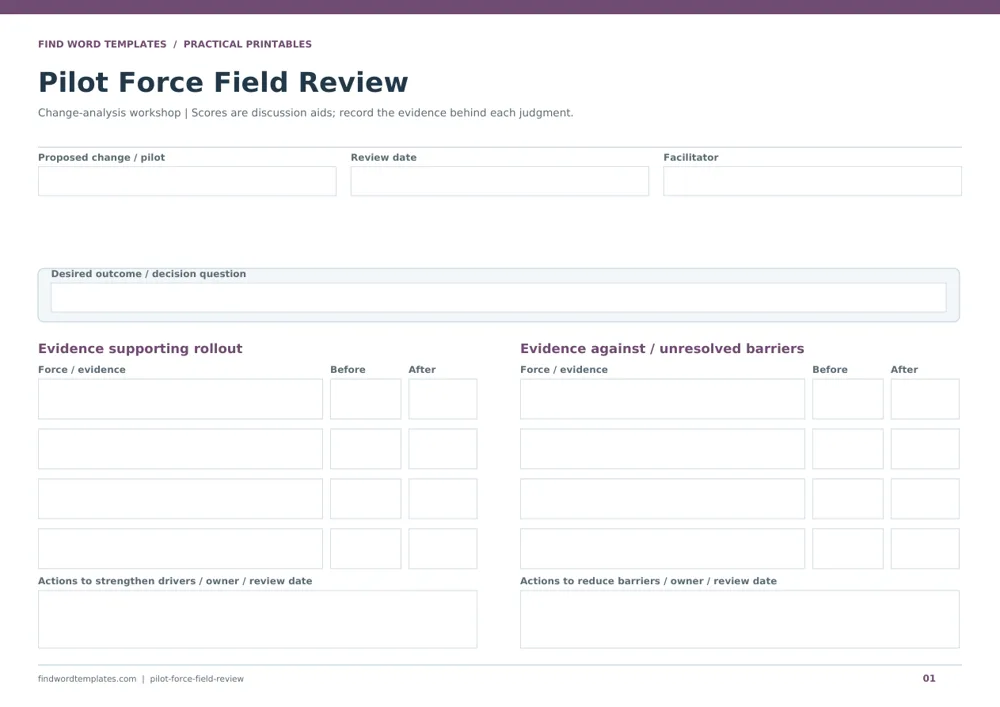
Pilot Force Field Review
A landscape pilot-review force field canvas with opposed force lists, evidence, scores, and follow-up actions.
Free Force Field Analysis Templates
Browse the templates below. The first four include download links to their original sources.
Force Field Analysis Template 1


Force Field Analysis Template 5 (Preview Only)

Force Field Analysis Template 6 (Preview Only)

Force Field Analysis Template 7 (Preview Only)

Force Field Analysis Template 8 (Preview Only)

Force Field Analysis Template 9 (Preview Only)

Force Field Analysis Template 10 (Preview Only)

When to Use Force Field Analysis
- Before launching a new process, system, or policy
- When a change initiative seems to be stalling
- During strategic planning or project kickoff meetings
- When choosing between options and needing a structured comparison
- For personal decisions such as a job move or a major purchase
How to Complete a Force Field Analysis
- Define the change or goal in one clear sentence.
- List all driving forces that support the change.
- List all restraining forces that work against it.
- Score each force from 1 (weak) to 5 (strong).
- Add up the scores on each side and compare them.
- Choose actions that strengthen drivers or, better, reduce the strongest restraining forces.
- Review the analysis regularly as conditions change.
Tips for Better Analysis
- Involve people from different teams so you catch hidden barriers.
- Be specific: “limited training budget” is more useful than “lack of resources.”
- Focus first on reducing restraining forces, since adding pressure often increases resistance.
- Use data where you can to back up your scores.
- Keep the finished analysis to share with stakeholders.
Use an affinity diagram first if the team needs to group a large collection of ideas about the proposed change.
Force field analysis helps you make change decisions with your eyes open. Choose a template from the ten above, list the forces honestly, and use the results to build a plan that strengthens what helps and reduces what holds you back.
Defining the Change Before Scoring It
A force field analysis becomes easier to use when the goal is specific. “Improve the business” gives a group too many directions to discuss at once. “Move the customer support team from shared email to a ticketing system over the next quarter” provides a clearer subject. It identifies the work affected, the proposed approach, and a period the participants can consider together.
Write the current situation beside the desired situation. Include boundaries such as the team involved and what the exercise will leave outside its scope. If participants are debating different changes, their lists will be difficult to compare even when all their observations are reasonable. Agree on the question first and revise it if the discussion reveals that it is too broad.
Choose participants who see different parts of the work. A manager may emphasize reporting, while an agent notices interruptions and an administrator notices setup effort. Ask each person for concrete observations before combining similar entries. Keep distinct causes separate: a lack of training time and a lack of suitable training materials may require different responses.
A Worked Example for a Support-Team Change
Suppose a small support team is considering a shared ticketing system. It identifies three drivers: clearer ownership of requests, scored 4; easier reporting, scored 3; and fewer lost messages, scored 4. On a five-point scale, those drivers total 11. Its restraints are limited training time, scored 4; setup effort, scored 3; and concern about duplicate entry, scored 3, for a total of 10.
Those totals summarize the group’s judgments; they do not measure an objective probability of success. The one-point difference is a reason to inspect the assumptions, not an automatic decision to proceed. A team member might rate training time more strongly because a busy season is approaching. Record that explanation so the workshop retains the information behind the number.
Next, turn the strongest barriers into actions. The training concern might lead to a short pilot with two agents and a protected practice session. The duplicate-entry concern might lead to testing how requests move from the old inbox to the new system. Give each action an owner and a date, then state what result would make the team reassess the change.
After the pilot, update the analysis using what was observed. If the setup took less effort than expected, revise that restraint and note why. If duplicate entry remains a problem, keep it visible instead of lowering the score merely because the project has started. Preserve the original version so readers can see how the assessment changed.
Keeping Scores and Follow-Up Useful
Define the ends of the rating scale before anyone scores. For example, a score of 1 could mean a minor influence that is easy to manage, while 5 means an influence likely to affect the proposed change substantially. Use the same interpretation for both sides. A force’s importance and the team’s confidence in its evidence are different things, so capture uncertainty in a note rather than hiding it inside an unexplained rating.
Check for duplicate entries before adding totals. “Staff have no time,” “training takes time,” and “busy schedules” may describe one underlying restraint. Counting all three can overstate that factor. Conversely, avoid merging unrelated concerns under a heading such as “people issues,” because that makes it difficult to identify a practical action.
Review the completed worksheet with the participants and identify unanswered questions. An assumption about cost may need a quotation; an assumption about customer demand may need a small test. Record those as information-gathering actions. A useful analysis can end with “we need this evidence before deciding” rather than forcing a premature yes-or-no conclusion.
Keep the action list short enough to review. At the next meeting, check whether the agreed actions occurred, what evidence they produced, and whether the change itself needs to be revised. This connects the force field diagram to work the team can observe instead of leaving it as an attractive workshop slide.
Frequently Asked Questions (FAQs)
What is force field analysis?
It is a framework for evaluating the forces that help or hinder a proposed change, developed by Kurt Lewin. It helps you decide whether to proceed and how to improve your chances.
What are driving and restraining forces?
Driving forces push toward change, such as cost savings or customer demand. Restraining forces resist it, such as fear, cost, or lack of skills.
Who uses force field analysis?
Managers, team leaders, consultants, project managers, and educators use it, as do individuals facing personal decisions.
How do I score the forces?
Rate each force on a scale, commonly 1 to 5, based on its strength or impact. Add up each side to see which is stronger.
Is force field analysis the same as SWOT?
No. SWOT looks at strengths, weaknesses, opportunities, and threats of an organization. Force field analysis focuses on the forces around one specific change.
Can I use these templates in Word or PowerPoint?
Yes. Use the layouts as a guide and recreate them in Word, PowerPoint, or Excel, or download the linked files where provided.
Are these templates free?
Yes, all templates on this page are free to view and use.
What if the group disagrees on a force’s score?
Record the range and ask what evidence or experience explains the difference. Agree on a provisional score only if it helps the discussion, and retain the uncertainty. A numerical average should not erase an important unresolved concern.





You must be logged in to post a comment.